RISK
Invisible in answer engines
A page can rank and still miss AI answers. Weak structure and weak sources cause that.
Answer Readiness Coach
AnswerLint identifies unclear answers, missing trust signals, weak evidence, and citation barriers—then shows exactly what to improve.
Instant validation
npx answerlint@latest audit --url https://website.comLocal checks · Deterministic · No LLM required
Immediate path
Start with commercial impact, competitor exposure, and the pages most likely to lose AI citation share.
✓Prioritize revenue and trust pages first.
✓Explain whether AI systems can quote the page.
✓Turn audit gaps into a short fix plan.
AI answer readiness
Content outcome
Needs improvement
3 issues prevent strong citation readiness
Improve first: Add visible authorship, freshness metadata, and source-backed claims.
live CLI simulation
$ npx answerlint@latest audit --url https://website.com
fetch sitemap.xml discovered 42 urls
crawl selected /pricing, /docs, /compare for audit
pass robots and canonical signals detected
pass answer-first headings found
warn FAQPage schema missing on /compare
warn dateModified missing on /docs
score composite 82 aeo 88 geo 76
fail GEO threshold 90 not met
Process exited with code 1 (Threshold failed)
Composite
+12 vs floor
AEO
answer ready
GEO
trust gaps
best tools for AI visibility audits
/compare/ai-visibility
PASSING91AEO checklist for launch pages
/docs/aeo-checklist
FIX QUEUED64GEO audit in CI pipeline
/guides/ci
AT RISK44AI answer readiness workflow
A simple, evidence-backed path from vague content to clearer answers, stronger trust signals, and better citation readiness.
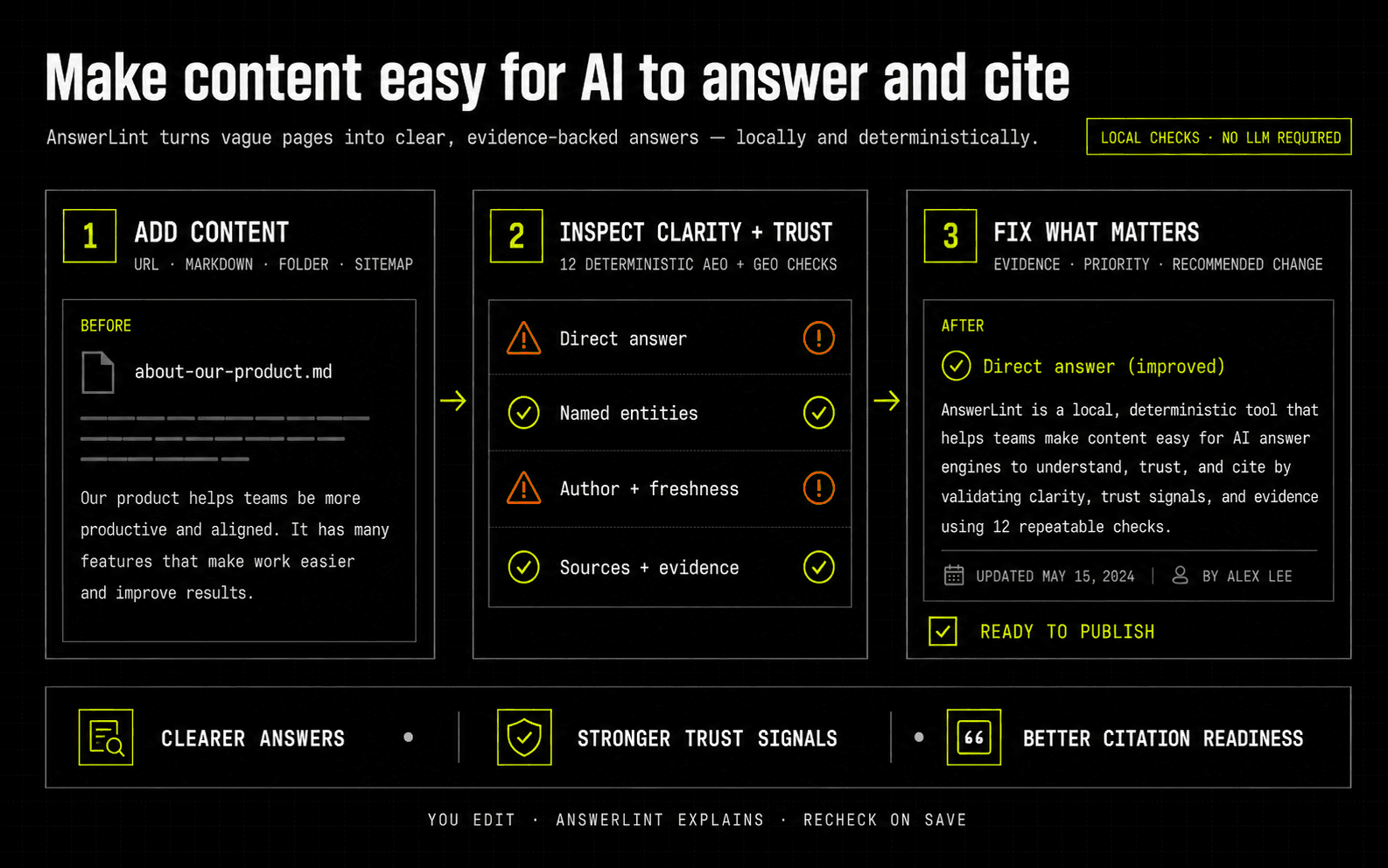
Open full size to inspect every signal.
Open the full-size workflow infographicStart with a URL, Markdown or HTML file, folder, or sitemap. Your local files stay local.
Check direct answers, entities, authorship, freshness, sources, structure, and citation readiness.
See the affected content, why the signal matters, and the exact recommended change.
Edit the source yourself, compare before and after, and confirm that important signals improved.
Why now
AI discovery does not reward pages just because they exist. It rewards pages that answer cleanly, cite clearly, and expose enough trust for a model to use them.
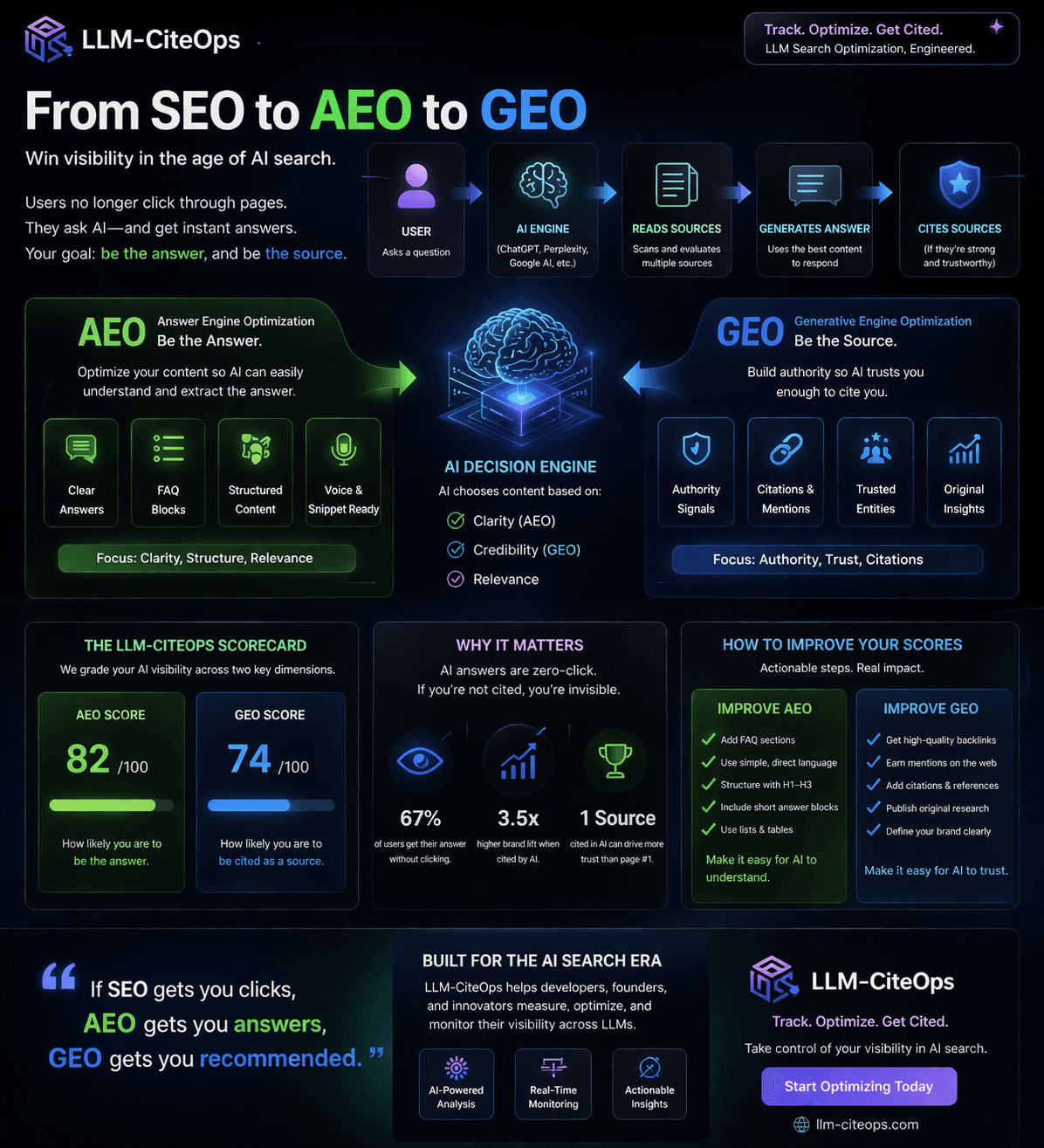
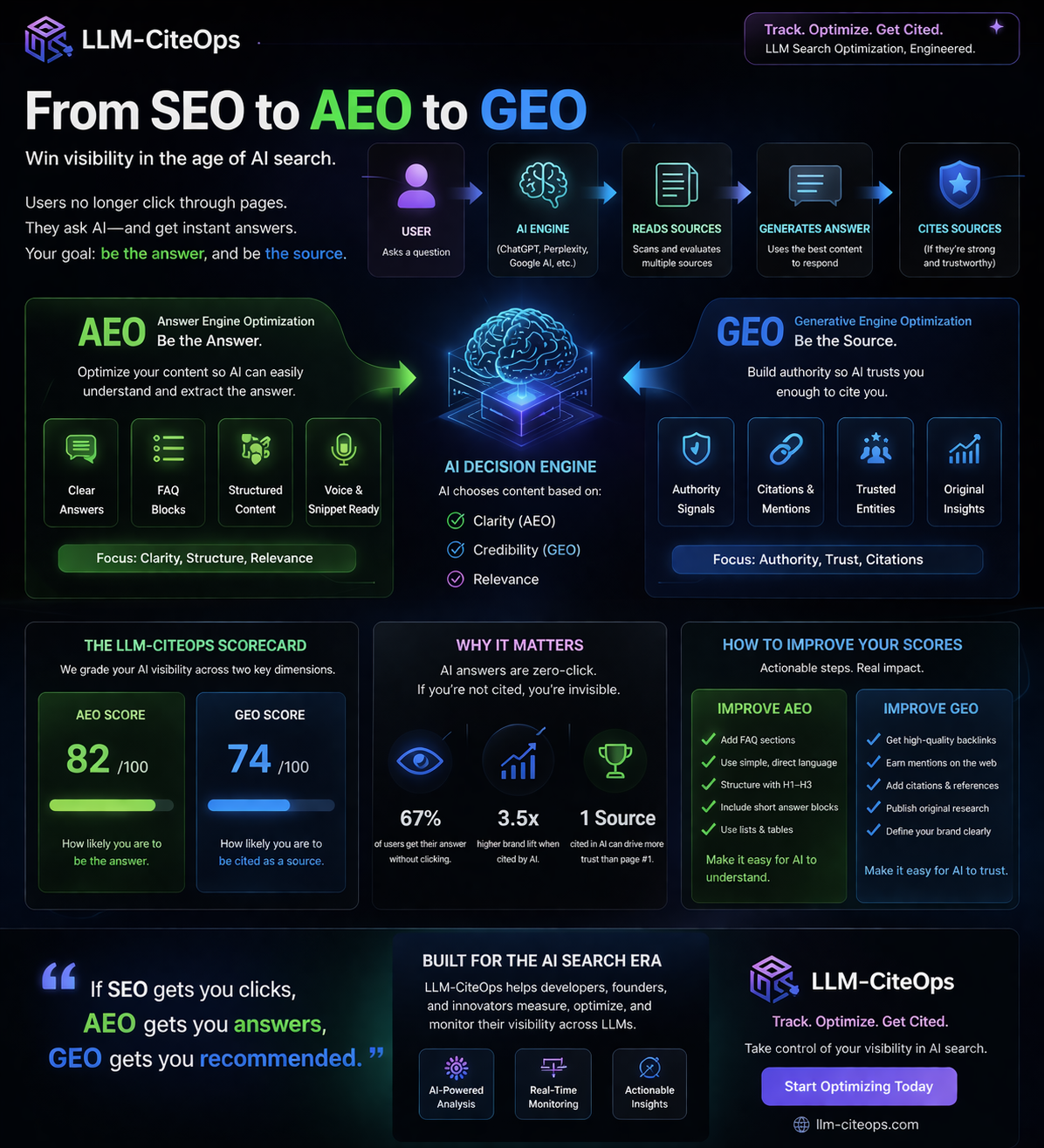
AEO helps you become the answer. GEO helps AI systems treat your page as a reliable source. AnswerLint audits both so the team can see the whole risk profile.
Think ESLint for AI-ready content: one repeatable score, one evidence trail, and one release bar for content, SEO, and engineering.
Standard SEO result
10 blue links for "AI visibility audit"
Ranking still matters, but the click path is increasingly hidden behind generated answers.
AI citation layer
+31 cite fit"AnswerLint identifies missing FAQ schema, freshness metadata, and citation gaps before launch."
RISK
A page can rank and still miss AI answers. Weak structure and weak sources cause that.
RISK
Leaders want risk and impact. Devs want clear markup fixes. Many audits speak to only one group.
RISK
Compare side by side. Then you know if a low score is OK—or if a rival wins AI cites.
If answer visibility matters, it needs a release standard.
Who it is for
Say why this helps the business. Say how fast the team can act.
Evidence workspace
Lead with reach, trust, and rival risk. Say what the score means. Say how it hits demand.
01Explain whether the page is likely to be quoted or skipped.
02Call out the commercial risk of weak trust and freshness signals.
03Summarize the top 3 changes that most improve discoverability.
Executive Summary
The page answers the core buyer question, but weak source attribution and missing schema make it easier for competitors to be cited in AI summaries.
Risk
Schema gap
Risk
Freshness weak
Risk
Citations thin
Readable outputs
HTML · JSON · CSV
Inputs covered
URL · file · folder · sitemap
Release gates
Thresholds & exit codes
Built for
Business · SEO · Engineering
Product layer
Start with a clear content outcome, inspect the evidence, then use AEO, GEO, and composite scores as supporting diagnostic context.
Operating principle
Clearer answers
Operating principle
Stronger trust signals
Operating principle
Better citation readiness
HTML for stakeholders, JSON for pipelines, CSV for sitemap or folder runs.
Optional .answerlint.json in the repo or home directory; override path per run.
Exit codes for pass, score failure, network errors, and bad input—mirror how you run Lighthouse in CI.
Read-only fetches, configurable rate limits, and robots awareness for compliant crawling.
Watch Markdown or MDX files with the terminal UI and refresh readiness findings whenever you save—without uploading content.
Compare one live URL against a competitor URL to see score deltas, parity gaps, and first fixes.
Free tool
Turn a public website into a deterministic AI roadmap, inspect the output, and download files ready to publish.
Report intelligence
The strongest audit experience explains commercial risk first, then backs it with exact evidence and implementation details.
Audience 01
Answer readiness is promising, but the page is under-signaling trust. Improve freshness, citation quality, and structured guidance to make it more quotable.
IMPACT 01
A short summary of whether this page is likely to earn trust and citations.
IMPACT 02
A simple statement of competitive position: behind, equal, or ahead.
IMPACT 03
Three highest-value actions tied to visibility impact, not technical jargon.
Sample output
Composite
74
AEO
81
GEO
68
Audience 02
DEV-1Audit evidence for each failed check, including the exact missing signal.
DEV-2Suggested schema, content structure, citation, and metadata improvements.
DEV-3Machine-readable outputs for CI gates, diffing, and automation.
CI command
answerlint audit --url "$DEPLOY_URL" --ci --threshold 9001 / commit
02 / audit
03 / block if GEO < 90
Highest-value fixes
Publish stronger authorship and freshness metadata.
Expand support links to trusted external sources.
Turn core sections into answer-first blocks and FAQ markup.
Ship workflow
Start with the playground, then move the workflow into the repo so every important page ships with an answer-visibility bar.
.github/workflows/answerlint.yml
name: AnswerLint audit

on:
  pull_request:
  push:
    branches: [master]

jobs:
  ai-visibility-gate:
    runs-on: ubuntu-latest
    steps:
      - uses: actions/checkout@v4
      - run: npx answerlint@latest audit --url "$DEPLOY_URL" --ci --threshold 90
CI/CD release gate
01
content change
02
preview URL
03
AEO + GEO gate
04
GEO score < 90
Run the same checks locally, in CI, or across a sitemap.
Share a readable report with non-technical stakeholders without hiding the underlying evidence.
Use the playground for fast exploration, then move the workflow into your repo.
Developer workflow
These are the practical workflows teams care about when they move from one-off checks to repeatable release habits.
Teams run AnswerLint against production-like HTTPS URLs so they can review answer readiness, trust signals, and citation gaps before a page ships.
Teams export HTML and JSON reports into GitHub workflows, compare score changes across releases, and block merges when the agreed bar drops.
HTML works for human review, JSON fits automation, and CSV helps content ops benchmark many URLs or compare a launch page against a competitor.
Comparison & alternatives
Should you audit by hand? Use a chat model? Or run an answer-readiness linter on each release? This lines up three paths.
Deterministic release tool
Opinionated pickRepeatable scoring
AEO, GEO, and combined scores you can export.
Workflow fit
Runs local, in CI, and in batch reviews.
Evidence and outputs
Returns HTML, JSON, and CSV with clear findings.
Best use case
Teams that need one list of what to fix next.
Human review
Repeatable scoring
Often subjective. Scores drift by reviewer.
Workflow fit
Hard to scale across many pages or ships.
Evidence and outputs
Proof often lives in notes or sheets.
Best use case
Small one-off reviews or editorial spot checks.
Prompted summary
Repeatable scoring
It can sum things up. It does not give a steady audit line.
Workflow fit
Fine for ideas. Weak for rules and release gates.
Evidence and outputs
Quality depends on the prompt. It is hard to compare runs.
Best use case
Early research or narrative drafting.
Concepts
Both aim for visibility when answers are generated, not just ten blue links. AnswerLint checks your content with that lens.
AEO is for engines that pull short answers. Think snippets, voice, and Q&A blocks. Use clear headings and facts. That helps you get cited.
AnswerLint shows gaps in clarity and structure. It shows what models need to quote you.
GEO is for AI that reads many pages at once. Use one brand name. Add facts you can trace. Use clean HTML. That cuts wrong AI facts and keeps your brand right.
AnswerLint scores GEO with AEO. You see combined risk, not one vanity score.
Live audit report
Runs anywhere you run Node—local, CI, or container.
FAQ
Content, SEO, and devs ask these when they pick AI visibility tools.
It checks if a page can be the answer and the source. One report scores clarity, structure, trust, dates, and cite fit.
Manual review can spark ideas. It is slow and uneven. AnswerLint gives a steady audit, a score you can track, and fixes for writers, SEO, and devs.
Yes. Devs can run it on URLs, files, folders, and sitemaps. They can export HTML, JSON, or CSV. They can set CI floors to block ships when scores slip.
AEO helps when buyers ask plain questions. GEO helps when AI picks which sites to trust. B2B teams need both to show up in AI-led discovery.
Specific experiences from people who have tried AnswerLint in real workflows.
“AnswerLint began with a Lighthouse-inspired idea: give developers and business teams a practical way to improve AEO and GEO without compromising either experience.”
Author
Rakesh Cheekatimala builds AnswerLint, an AI-visibility linting system for modern content teams.
npm package updated
Use the playground for quick exploration, then move the same workflow into the CLI and CI. Reports stay local and under your control.
Install
npx answerlint@latest audit --url https://website.com